Reports
Which Sri Lankan jobs are most exposed to AI, and who is building for them
BuiltList, Sri Lanka's startup and product directory, maps Anthropic's 2026 AI job data to Sri Lanka's 8,079,040 workers and 81 local AI tools.
BuiltList10 min read
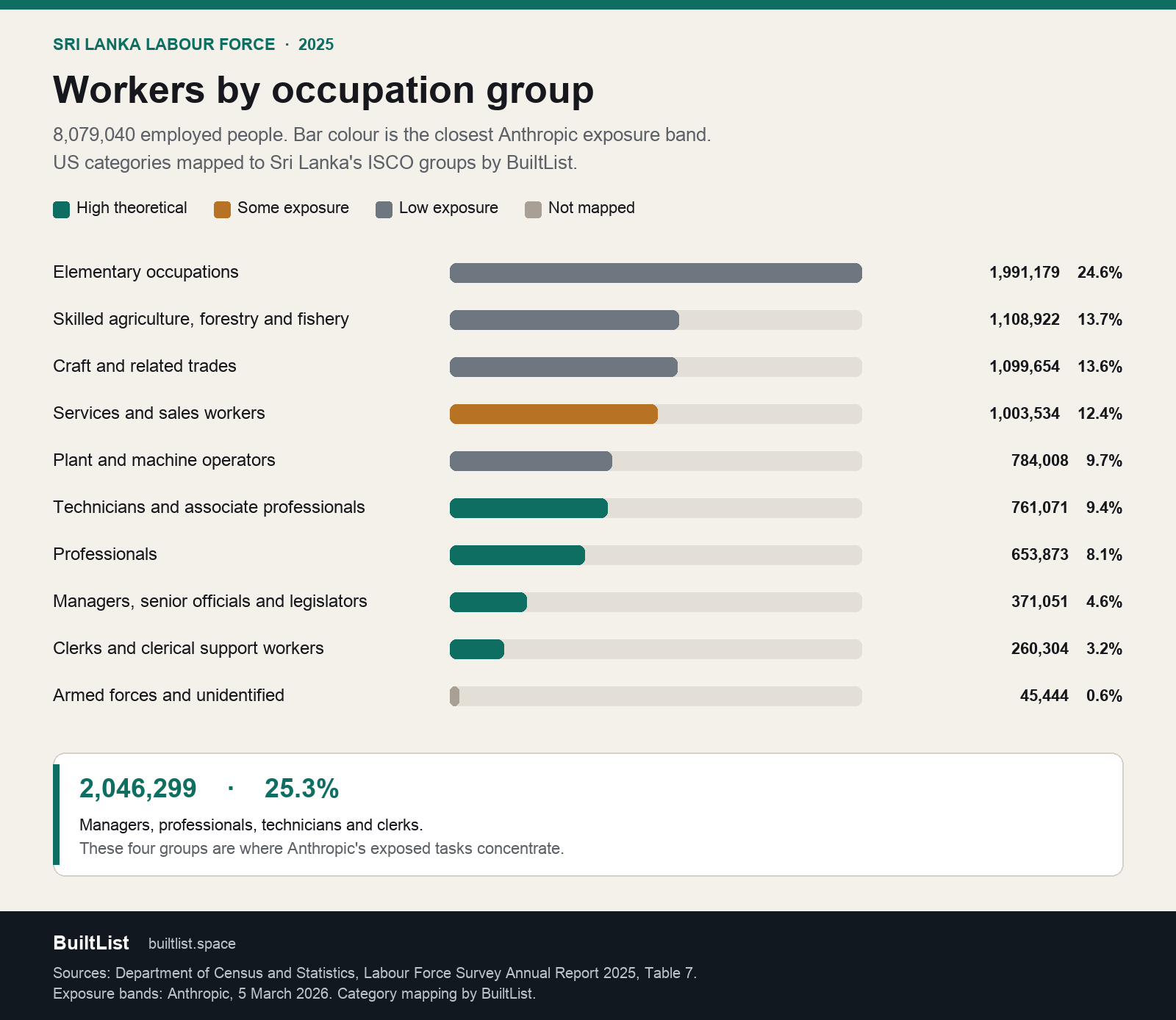
Anthropic's March 2026 study finds AI could theoretically handle most tasks in computer and maths (94%) and office and admin (90%) jobs, but real use is far lower (33% in computer and maths). In Sri Lanka, 2,046,299 of 8,079,040 workers (25.3%) were managers, professionals, technicians or clerks in 2025, the groups where these tasks concentrate.
The chart above counts every occupation group in the 2025 labour force survey. The rest of this report puts Anthropic's US findings next to those groups, and next to the AI companies in Sri Lanka already building for this work.
What Anthropic actually found
On 5 March 2026, Anthropic published Labor market impacts of AI: A new measure and early evidence. The authors are economists Maxim Massenkoff and Peter McCrory.
The report builds a measure called observed exposure. It combines three things:
- The US O*NET database, which lists tasks for about 800 occupations.
- Anthropic's own Claude usage data, from the Anthropic Economic Index.
- A 2023 academic estimate, Eloundou et al., of whether a language model could make each task at least twice as fast.
A job scores higher when its tasks are possible with AI, show up often in work-related Claude use, and are automated rather than only assisted.
These are the ten most exposed US occupations in the report's Figure 3:
| Occupation (US) | Observed exposure |
|---|---|
| Computer programmers | 74.5% |
| Customer service representatives | 70.1% |
| Data entry keyers | 67.1% |
| Medical record specialists | 66.7% |
| Market research analysts and marketing specialists | 64.8% |
| Sales representatives, wholesale and manufacturing, except technical and scientific products | 62.8% |
| Financial and investment analysts | 57.2% |
| Software quality assurance analysts and testers | 51.9% |
| Information security analysts | 48.6% |
| Computer user support specialists | 46.8% |
Source: Anthropic, 5 March 2026, Figure 3. The article text rounds computer programmers to 75% and data entry keyers to 67%.
At the other end, 30% of US workers had zero coverage. Their tasks were too rare in the Claude data to count. Examples include cooks, motorcycle mechanics, lifeguards, bartenders, dishwashers and dressing room attendants.
The gap between what AI could do and what it does
The headline finding is a gap. AI is "far from reaching its theoretical capability," the report says.
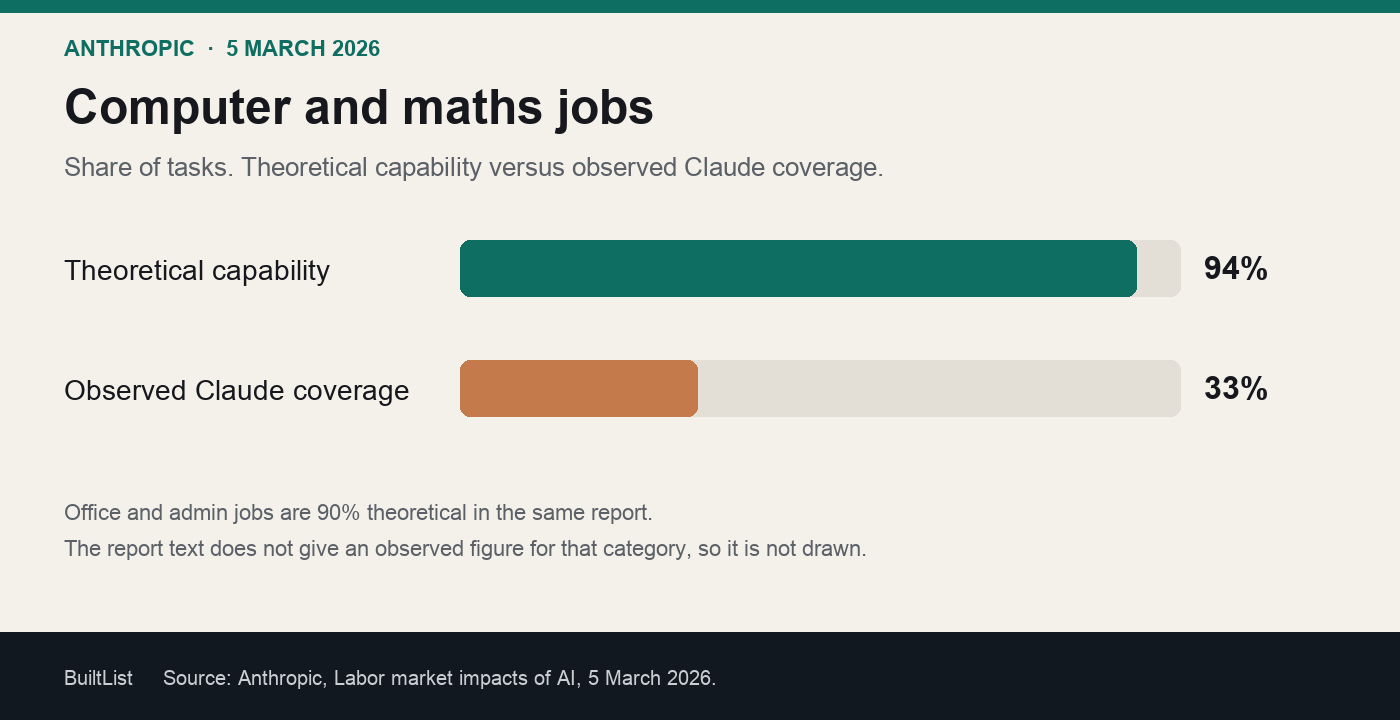
In computer and maths jobs, AI could theoretically speed up 94% of tasks. Claude currently covers 33%. In office and admin jobs, the theoretical figure is 90%. The report text does not publish an observed figure for office and admin, so the chart above leaves it out. Business and finance, management, legal, and arts and media also show high theoretical coverage in Figure 2, with much lower observed use. This article does not read extra percentages off that chart.
Anthropic gives reasons for the gap: model limits, legal constraints, specific software requirements, and human verification steps.
On jobs so far, the findings are cautious:
- Anthropic found "no systematic increase in unemployment for highly exposed workers since late 2022."
- It found suggestive evidence that hiring of workers aged 22 to 25 has slowed in exposed jobs. Their job-finding rate in those jobs fell 14% compared with 2022. The report calls this "just barely statistically significant." There was no such decrease for workers older than 25.
- For every 10 percentage point rise in coverage, US Bureau of Labor Statistics job-growth projections to 2034 drop by 0.6 percentage points.
A second Anthropic report, Working with AI (23 November 2026), matters for Sri Lanka. Nathan Wilmers, Maxim Massenkoff and Peter McCrory based it on 66 interviews with 58 of Anthropic's enterprise customers. Nine companies described cutting contracted software developers, customer service staff, legal counsel and back-office work, "many of which they had already offshored." The authors say these cuts "could be an early warning of job disruption in the international business services industry."
That industry is a large employer here. Daily FT reported on 15 July 2026, as SLASSCOM prepared for its annual general meeting, that the industry comprises more than 680 IT and BPM companies and a workforce of about 175,000 professionals. That figure is the newspaper's account of the industry, not a separate SLASSCOM statistics release.
How many Sri Lankans work in exposed job groups
Anthropic's data is American. To see what it means here, this report uses the Department of Census and Statistics Sri Lanka Labour Force Survey Annual Report 2025, preface dated 15 September 2026.
Sri Lanka had 8,079,040 employed people in 2025. Table 7 splits them into ten occupation groups. The chart at the top ranks those groups by headcount. The table below keeps the survey's own order, next to the closest Anthropic categories.
| Sri Lanka occupation group (ISCO-08) | Workers, 2025 | Share | Closest Anthropic categories and finding |
|---|---|---|---|
| Managers, senior officials and legislators | 371,051 | 4.6% | Management: high theoretical, low observed |
| Professionals | 653,873 | 8.1% | Computer and maths (94% theoretical, 33% observed); business and finance, legal, arts and media: high theoretical |
| Technicians and associate professionals | 761,071 | 9.4% | Includes IT support and finance roles in Anthropic's top 10 |
| Clerks and clerical support workers | 260,304 | 3.2% | Office and admin: 90% theoretical; data entry keyers 67.1% observed |
| Services and sales workers | 1,003,534 | 12.4% | Sales: some exposure; personal care and food serving: low |
| Skilled agriculture, forestry and fishery | 1,108,922 | 13.7% | Agriculture: low |
| Craft and related trades | 1,099,654 | 13.6% | Construction, installation and repair: low |
| Plant and machine operators and assemblers | 784,008 | 9.7% | Production and transport: low |
| Elementary occupations | 1,991,179 | 24.6% | Mostly physical work: low |
| Armed forces and unidentified occupations | 45,444 | 0.6% | Not mapped. The household survey does not fully cover institutional armed forces |
Sources: DCS Labour Force Survey Annual Report 2025, Table 7 and Table 4.5; Anthropic, 5 March 2026, Figure 2. Mapping US categories to ISCO groups is BuiltList's approximation. The ten groups sum to 8,079,040.
Three things stand out:
- The four white-collar groups (managers, professionals, technicians, clerks) add up to 2,046,299 workers, or 25.3% of Sri Lanka's workforce.
- The four mostly manual groups (agriculture, crafts, machine operators, elementary jobs) add up to 4,983,763 workers, or 61.7%. Anthropic's data suggests these jobs are the least touched by AI today.
- The remaining workers are in services and sales (1,003,534) or in armed forces and unidentified occupations (45,444).
Sri Lanka's "professionals" group is broader than tech. DCS says it "generally consist of teachers, nurses, doctors, etc." Women are 63.0% of that group (Table 4.5). Those are jobs where Anthropic sees less observed use than in programming, customer service and data entry.
What the World Bank and ILO say about Sri Lanka
Two other primary studies look at developing economies directly.
World Bank, October 2025. The South Asia Development Update: Jobs, AI, and Trade found:
- "Bhutan and Sri Lanka exhibit the highest exposure rates" in South Asia, "reflecting their relatively more skilled and educated workforces." The underlying labour-force surveys are each country's latest available year in the World Bank's data.
- On jobs where AI helps workers rather than stands in for them, "India ranks highest in the share of exposed jobs that are complementary, while Sri Lanka ranks lowest."
- Demand for AI skills is growing fast, "driven primarily by an explosion of demand in India and Sri Lanka." Jobs that require AI skills pay a premium of nearly 30% over other white-collar jobs.
- In the same South Asia report, job postings for business services roles fell 35% and wages 8% since ChatGPT's release, relative to other sectors. The report also notes the sector's exports are still growing. Those two percentages are for South Asia, not for Sri Lanka alone.
ILO, May 2025. Generative AI and Jobs: A Refined Global Index of Occupational Exposure (Working Paper 140) found that one in four workers worldwide is in an occupation with some generative AI exposure. Clerical jobs remain the most exposed. Exposure is 34% of employment in high-income countries and 11% in low-income countries. The ILO says "transformation of jobs is the most likely impact of GenAI."
Sri Lankan AI startups building for these jobs
BuiltList lists 81 AI products built by Sri Lankans, checked on 25 November 2026. Many target the job areas Anthropic flags. The short lines below are taken from each listing on that page.
| Exposed job area (Anthropic) | Sri Lankan AI products on BuiltList |
|---|---|
| Customer service representatives | ConnectBox: AI CRM that brings WhatsApp, Messenger, Instagram and calls into one inbox. Chatty: AI support agents trained on your website. HTGWA CLOUD: WhatsApp automation with multilingual AI. Peak Edu: AI student support line in three languages. |
| Data entry and office admin | Reqmora: collects clients' monthly documents, chases what's missing and checks each one. Requester: AI-native approval workflows. Briv: "An AI Chief Of Staff For Business Owners". Klara: AI operations manager. |
| Business, finance and accounting | Taxxa AI: "Second brain for modern accounting". XenLoop: AI app for bills and renewals. |
| Marketing and sales | Lium Lium: personalised AI cold email outreach. Convertlr.com: AI sales agent inside WhatsApp. Seonoob: SEO and AI visibility platform. |
| Software and QA | Issuenuet AI: AI bug triage and duplicate ticket detection. Tantalum IDE: Arduino IDE with an agentic AI assistant. |
| Hiring and job seekers | Talvin AI: AI candidate screening. StrongCV: free AI CV check for Sri Lankan job seekers. Ergon AI: AI career agent. Sri Lankan Jobs Agent: open-source agent that ranks Sri Lankan jobs against your CV. |
| Reskilling | Zuu Crew AI: data and AI academy. Delta Camp: AI-first skills for non-technical professionals. Buildr Labs: learn AI by building. |
AI is also reaching low-exposure sectors. RiceVision, the top-voted AI product on BuiltList, offers "AI-powered satellite monitoring for smarter rice cultivation." Concolabs Inc is AI for construction cost management. Aiboq is for faster construction estimates.
Most of these listings describe tools that help a team handle more work.
What workers and founders can do now
For workers in exposed roles:
- Learn to use AI on your own tasks first. The World Bank found AI-skill jobs pay nearly 30% more than other white-collar jobs.
- Move toward the tasks AI handles poorly: judgment, client relationships, and checking AI output. Anthropic's enterprise interviews found companies redeploying staff to these bottleneck tasks.
- Watch entry-level hiring. Both Anthropic and the World Bank saw early signs it is slowing in exposed jobs.
For founders:
- Build where adoption is still low. Anthropic's gap between theoretical and observed use is the opportunity, especially in legal, finance and admin work.
- Build for Sri Lankan conditions: Sinhala and Tamil, WhatsApp-first customers, and local tax and compliance.
- If you build an AI product, submit it to BuiltList so buyers and job seekers can find it.
Limits of this data
- Exposure means AI can do or speed up some tasks. Anthropic, the ILO and the World Bank each treat exposure as separate from job loss.
- Anthropic's data is US-based. It uses US occupations and Claude usage. A Sri Lankan job with the same title can involve different tasks.
- It reflects one AI product. Observed exposure counts Claude use only, not other AI tools.
- The category match is ours. We matched US categories to Sri Lanka's ISCO groups by hand. Treat the table as a guide.
- Survey limits. The DCS survey covers the household population only, so institutional armed forces are not fully represented. DCS revised the 2025 figures using the 2024 Census of Population and Housing.
FAQ
Which jobs are most exposed to AI according to Anthropic? Anthropic's March 2026 report lists computer programmers (74.5%), customer service representatives (70.1%) and data entry keyers (67.1%) as the most exposed US occupations. Computer and maths, and office and admin work, have the highest theoretical exposure.
How many Sri Lankans work in AI-exposed job groups? In 2025, 2,046,299 of Sri Lanka's 8,079,040 workers (25.3%) were managers, professionals, technicians or clerks, per the DCS Labour Force Survey. These groups hold most AI-exposed tasks. Not every job in them is exposed. Another 45,444 workers were in armed forces or unidentified occupations.
Will AI replace jobs in Sri Lanka? The evidence so far points to tasks changing inside jobs. Anthropic found no systematic rise in US unemployment for exposed workers since late 2022. The ILO says job transformation is the most likely impact. Hiring for young workers in exposed jobs may slow.
Is Sri Lanka more exposed to AI than other South Asian countries? Yes. The World Bank's October 2025 South Asia Development Update says Bhutan and Sri Lanka have the highest AI exposure in the region. It also found Sri Lanka has the lowest share of exposed jobs where AI complements workers.
Which Sri Lankan startups are building AI for these jobs? BuiltList, Sri Lanka's startup and product directory, lists 81 AI products. Examples include ConnectBox and Chatty for customer service, Reqmora for document collection, Taxxa AI for accounting and Talvin AI for hiring. See the full list on AI companies in Sri Lanka.
Sources
All opened on 25 November 2026.
- Anthropic, Massenkoff and McCrory, "Labor market impacts of AI: A new measure and early evidence", 5 March 2026. anthropic.com/research/labor-market-impacts. Appendix: assets.claude.com.
- Anthropic, Wilmers, Massenkoff and McCrory, "Working with AI", 23 November 2026. anthropic.com/research/working-with-ai.
- Department of Census and Statistics, Sri Lanka Labour Force Survey Annual Report 2025, preface dated 15 September 2026, Table 4.5 and Table 7. statistics.gov.lk.
- World Bank, South Asia Development Update: Jobs, AI, and Trade, October 2025. Full text. Chapter 2 highlights.
- ILO, Generative AI and Jobs: A Refined Global Index of Occupational Exposure, Working Paper 140, May 2025. ilo.org. PDF.
- Daily FT, "SLASSCOM reflects on a year of creating opportunities, strengthening Sri Lanka's knowledge and innovation industry", 15 July 2026. ft.lk.
- BuiltList, AI companies in Sri Lanka, 81 listings, fetched 25 November 2026. builtlist.space/startups-sri-lanka/ai.
 In partnership with Kiwi Money