What Budget 2027 means for Sri Lankan startups and builders
Budget 2027 raises the Digital Economy ministry allocation from Rs 18.5 billion to Rs 28.5 billion and names a Digital Startup Fund of Funds.
BuiltList18 min read
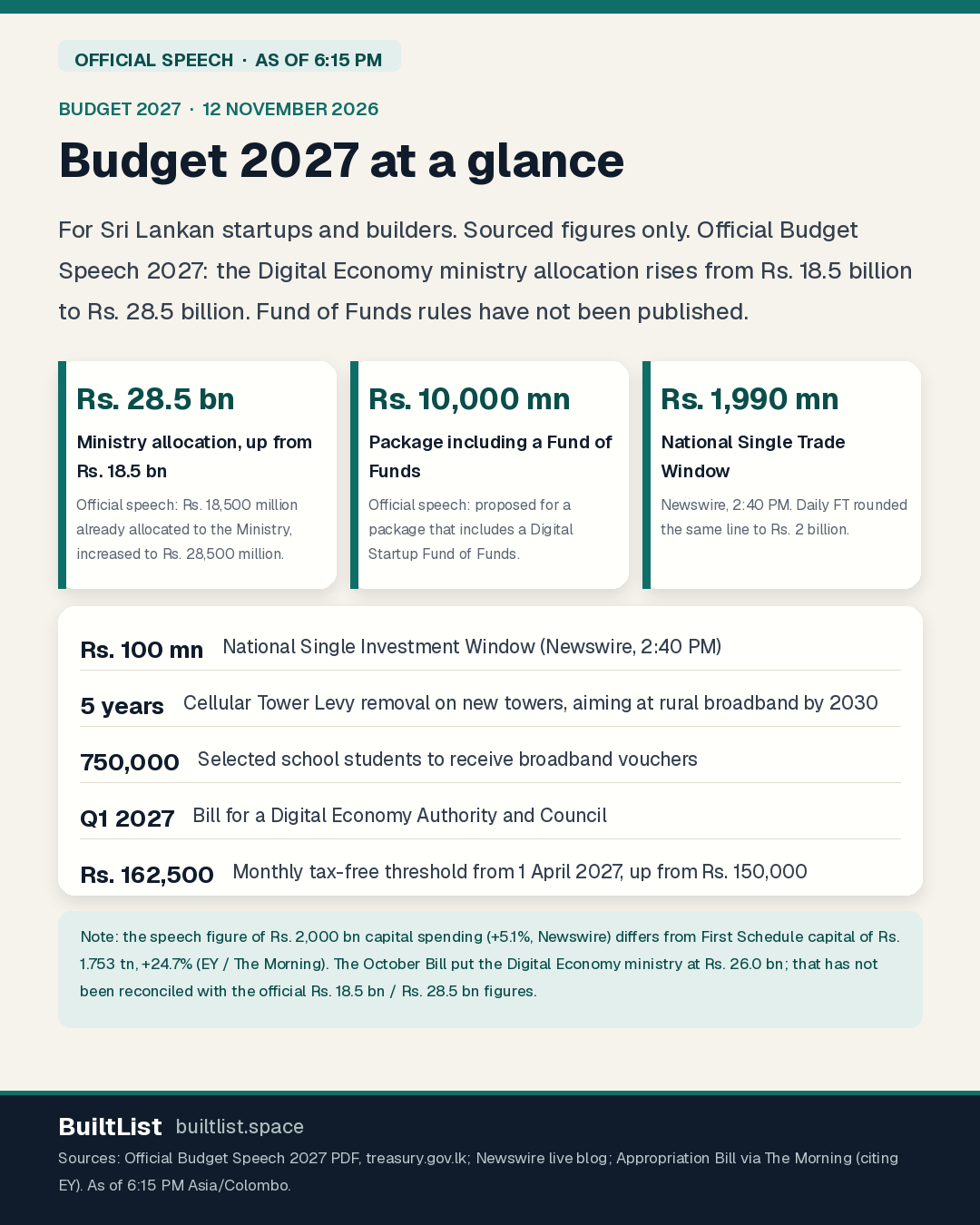
Sri Lanka’s 2027 Budget speech has been delivered in Parliament, and the official speech is now on the Treasury website. The short version for founders, from the official English text: Rs. 18,500 million has already been allocated to the Ministry of Digital Economy for 2027 under six key areas, and this amount will be increased to Rs. 28,500 million. The speech also proposes Rs. 10,000 million for a package of digital measures, one of which is strengthening the Digital Startup Fund of Funds. Live blogs at 3:32 PM reported the same two totals as Rs. 28.5 billion for digital transformation, “the largest allocation for the digital sector in Sri Lanka’s history,” and Rs. 10 billion for digital startups — narrower wording than the official package. Full write-up: budget-2027-digital-transformation-rs-28-5-billion. A later Daily Mirror article, “Budget 2027 spending: where Sri Lanka’s money goes,” also reports the Digital economy allocation as Rs. 28.5 billion, raised from Rs. 18.5 billion. There is also money for single trade and investment windows, a legal timetable for the digital economy, an AI centre on Wijerama Mawatha, a push to adopt GovPay and QR payments, a five-year tax removal for new communication towers, and concessionary loan schemes for rural entrepreneurs, home-stay tourism and women-led households. Who can use the Fund of Funds, and most of the rules behind the other measures, have not been published.
Also in this series
- Digital Economy ministry allocation rises from Rs 18.5 billion to Rs 28.5 billion
- Digital Startup Fund of Funds, inside a Rs 10,000 million package
- National Single Trade Window (Rs 1,990 million)
- National Single Investment Window (Rs 100 million)
- Digital Economy Act, Authority, cyber and procurement
- AI Excellence Centre
- GoVTech and data protection
- GovPay and QR payments
- Communication-tower tax removal
- Rural entrepreneurship loan scheme (Rs 5,000 million)
- Personal income tax: monthly tax-free threshold rises to Rs 162,500 (and VAT on foreign-currency supplies)
Headline measures for builders
The President began the second reading at about 1:41 PM, according to Newswire’s live blog. The startup-, tech- and SME-credit-relevant lines landed between 2:35 PM and 3:45 PM.
Rs. 10,000 million is proposed “for the above proposals,” in the official Budget Speech 2027 — a package that includes “Strengthening the Digital Startup Fund of Funds to attract private investment into Sri Lankan businesses.” Live blogs compressed this. Newswire at 3:13 PM logged “Rs. 10,000 million has been allocated for a Digital Entrepreneurship Fund”; at 3:32 PM it recorded Rs. 10 billion for “digital startups and new digital ventures in the private sector.” Daily FT at 3:18 PM used “Rs. 10 billion Digital Entrepreneurship Fund to be established.” The name “Digital Entrepreneurship Fund” is not in the official English digital section. No administrator, eligibility rules, instrument or opening date was given. Full write-ups: budget-2027-digital-transformation-rs-28-5-billion and budget-2027-digital-startup-fund-of-funds.
A National Single Trade Window of Rs. 1,990 million and a National Single Investment Window of Rs. 100 million were logged by Newswire at 2:40 PM. Daily FT rounded the trade-window figure to Rs. 2 billion; Daily Mirror and Newswire both used Rs. 1,990 million. A related proposal, at 2:47 PM, would modernise duty-concession clearance for goods imported to make exports, aimed at small and medium-scale industries. OneTRADE, a National Single Window for Trade, already went live on 5 November for tea and coconut exports (Daily FT, 7 November), so today’s line is an allocation “for the establishment” of a window, not necessarily a first launch. Full write-ups: budget-2027-national-single-trade-window and budget-2027-national-single-investment-window.
Investment promotion will be “facilitated by a new government entity with 100% shareholding by the Treasury” (Newswire, 2:41 PM). Daily Mirror called it “a new dedicated company.” It was not named, and its relationship to the Board of Investment was not explained. At 2:35 PM the President said the government “will introduce a special incentives package” to encourage investment; no rates, sectors or start date were reported. The Investment Protection Bill “has been submitted to the Attorney General for legal clearance,” and the Colombo Port City Economic Commission Act “will be amended to attract foreign investment” (Newswire, 2:32 PM). Daily Mirror added that a Public-Private Partnership Act will be presented “in early 2027.”
A Digital Economy Act, a Cyber Security Authority in 2027, and a new procurement process for digital purchases were logged by Newswire at 3:09 PM (Daily Mirror carried the same wording at 3:04 PM). At 3:14 PM Newswire added that a bill to establish the Digital Economy Authority and the Digital Economy Council will be presented in the first quarter of 2027. The official speech names this the Digital Economy Bill, expected to be passed in the first quarter of 2027, and confirms that the Cyber Security Bill “has been submitted to the Attorney General for clearance,” with a Cyber Security Authority expected under it in 2027. Digital-procurement guidelines are to be introduced in the first half of 2027. The official speech also states that Rs. 18,500 million already allocated to the Ministry of Digital Economy “will be increased to Rs. 28,500 million.” Live blogs reported that Rs. 28.5 billion total at 3:14–3:32 PM as “the largest allocation for the digital sector in Sri Lanka’s history” — wording that is not in the official English paragraph. Full write-ups: budget-2027-digital-transformation-rs-28-5-billion and budget-2027-digital-economy-act-authority.
An AI Excellence Centre at Wijerama Mawatha will “strengthen AI capabilities, promote the responsible use of artificial intelligence and bring together government representatives, experts and members of the academic community under one roof” (Newswire, 3:06 PM). No separate allocation was given; the official speech lists the centre among the proposals covered by the Rs. 10,000 million package. Daily Mirror used the name “Centre of Excellence for Artificial Intelligence.” The official speech also confirms plans to digitise Divisional Secretariat and Grama Niladhari services and to launch a Presidential Digital Excellence Awards programme, which had earlier been Mirror-only. Full write-up: budget-2027-ai-excellence-centre.
GoVTech (100% Treasury-owned) has already begun operations on a roadmap to digitalise public services; the Personal Data Protection Act has been amended, and the Data Protection Authority has been activated (Newswire, 3:15 PM). These are status lines, not first-time creations: The Morning reported in August 2026 that the PDPA was amended by Act No. 22 of 2025 and that the Authority, established in 2023, had issued a public-sector circular. Ada Derana said state institutions “would be required to adopt digital systems through GovTech Sri Lanka,” and that new data-protection and digital-governance legislation was expected at the beginning of 2027. Those two Ada Derana readings had not appeared on the other live blogs. Full write-up: budget-2027-data-protection-govtech.
Adoption of GovPay and QR-based payment systems “to promote cashless transactions” was logged by Newswire at 3:27 PM, without an amount or a mandate. GovPay has been live since February 2025 (News First, 13 October 2026). This is a push to use an existing platform, not a new launch. Full write-up: budget-2027-govpay-qr-payments.
Taxes for new communication towers are to be removed for five years, to expand rural high-speed broadband by 2030 (Newswire, 3:20 PM). The official speech names this as a five-year removal of the Cellular Tower Levy on new telecommunication towers. It also confirms a Rs. 9,000 million allocation by the Telecommunications Regulatory Commission through the Gamata Sannivedanaya programme: a grant of 75 percent of the cost of a new tower, or Rs. 35 million, whichever is lower, plus Rs. 5 million for an electricity connection, aiming at 573 towers by 2028 and 700–800 by 2030. The official speech also states that broadband vouchers will be provided to 750,000 selected school students, which resolves the earlier live-blog uncertainty about whether the 750,000-student line and the voucher programme were the same. Full write-up: budget-2027-telecom-tower-tax-removal.
SME credit
Between 3:39 PM and 3:45 PM, Newswire logged three concessionary loan programmes, plus an interest-free fisheries scheme with no figure.
A Programme for Empowering Rural Enterprises is in the official speech: loans through the Samurdhi Bank of up to Rs. 5 million at 4%, if the borrower employs at least five Aswesuma beneficiaries. Rs. 200 million is proposed for interest subsidies; Rs. 5,000 million is the expected loan volume. Live blogs had reported the Rs. 5,000 million scheme without a per-borrower cap. Tenure, collateral and a definition of “rural” are still unstated. Full write-up: budget-2027-rural-entrepreneurship-loan-scheme.
A Home-Stay Loan Scheme will offer loans of up to Rs. 2 million at 3%. Official text: Rs. 100 million as the first-phase interest subsidy, and Rs. 7,500 million in expected loans. Live blogs had described Rs. 7.5 billion as the amount “allocated.”
A Loan Scheme for Uplifting Women-headed Families — official wording, not “women-led households” — will offer group loans of up to Rs. 1 million at 3% through Samurdhi Bank. Official text: Rs. 200 million as the first-phase interest subsidy, and Rs. 12,500 million in expected loans.
Newswire’s 3:41 PM “interest-free fisheries” line is not in the official English SME section as stated. The official text makes fisheries enterprises eligible for Re-MSME Plus, and proposes 5% loans of up to Rs. 500 million for large-scale fisheries industrialists (Rs. 15,000 million expected volume; Rs. 1,000 million in interest subsidies). Interest-free from 2027 is the pledge scheme for paddy mill owners. The official speech also names the Department of Development Finance website and an 1819 hotline as the access points for these schemes. These credit lines are separate from the Digital Startup Fund of Funds.
Macro numbers already used in the speech
These are the backdrop, not new startup schemes, all from Newswire unless noted.
The government “aims to increase capital expenditure by 5.1%, with Rs. 2,000 billion allocated for capital spending,” and “the government’s objective is to achieve sustained 7% annual economic growth” (2:23 PM). Daily FT recorded a tighter wording: “We hope to maintain a 7% GDP growth in 2027 and recurrent expenditure at 13.6% of GDP,” and later said the Rs. 2 trillion capital figure “amounts to 5.1% of GDP.” The official speech is now published; those live-blog phrasings have not been re-checked word-for-word against the PDF in this pass, so treat them as unreconciled until they are. There is also a capital-spending discrepancy: the speech figure is Rs. 2,000 billion, up 5.1%, while EY’s reading of the Bill’s First Schedule is Rs. 1.753 trillion, up 24.7% (The Morning). Those may be different definitions.
Other speech figures: public debt “reduced to 95% by the end of 2025”; the IMF’s sixth review projects 87% by 2032, against an original 95% programme aim; debt service of $3,707 million in 2025, projected $3,591 million in 2026, $2,986 million in 2027, and $3,574 million in 2028; interest payments down from 79.1% of government revenue in 2022 to 45.9% in 2025 and 39.6% by September 2026; foreign reserves having “exceeded $7 billion”; a sovereign-rating move from CC+ to B-; inflation up from 2.1% in December 2025 to 8.3% in October 2026; “loans extended by State banks to the private sector increased by 25% compared to 2024” (backward-looking, not a new scheme); expected remittances to exceed $9 billion; and more than Rs. 147 billion spent on relief, tied to the Middle East crisis. Vehicle imports were $1.6 billion in 2025, with LCs of $1.5 billion opened so far in 2026; fuel imports were $4,042 million in 2025 and $4,487 million by September 2026. A committee has been appointed to assess the need for an IMF programme after the current one, which the government hopes to complete (the EFF ends in March 2027, per Daily FT). Daily FT also reported him saying Sri Lanka had recorded “its lowest budget deficit in 68 years,” a phrasing that was not on Newswire or Daily Mirror at earlier checks. Daily Mirror quoted him on a production-based economy, “creating an investor-friendly environment, boosting export competitiveness and foreign exchange capacity,” and on reforms “to broaden the tax base, streamline tax exemptions, and digitalize tax administration.”
Two “Budget size” figures were already in the October Bill. Spending for ministries and departments is about Rs. 4.993 trillion (The Morning, citing EY; News First gives Rs. 4,992.77 billion). Daily FT adds statutory charges of Rs. 4.92 trillion, taking the combined provision to “approximately Rs. 9.92 trillion.” Net borrowing is capped at Rs. 3.8 trillion.
Other speech items logged, not startup-specific
Logged because they were in the same live blogs, but they are not the reason to read this roundup: a Customs Ordinance amendment expected by March 2027; Rs. 3,430 million (Newswire) / Rs. 3,400 million (Daily FT) for the Sri Lanka–Europe Economic and Trade Cooperation Programme; a committee to review the India FTA, and exploration of an FTA with China (Daily FT also mentioned West Asia and RCEP); PAL on the importation of newsprint and of batteries used for solar energy storage to be removed from 1 January 2027 (the official energy section, printed page 17, names the batteries without a date; Annexure V, paragraph 6.1, and Newswire at 6:20 PM put both items on that date; the tax-chapter speech text had named only newsprint, and quoted a 10 percent PAL rate only there); a rooftop-solar battery scheme of Rs. 25,000 per kW, capped at Rs. 250,000 for systems up to 10 kW, with Rs. 3,500 million allocated; Rs. 26.5 billion to strengthen the national power grid; free smart meters for 300,000 electricity consumers using more than 180 units, and for all LECO consumers over 120 units; fuel-storage, pipeline and refinery items (including Rs. 22.34 billion for a Muthurajawela–BIA jet-fuel pipeline and 92,000-tonne storage, and tenders for a Rs. 16,332 million Kolonnawa-to-Harbour pipeline); floating solar and a 30 MW battery at Norochcholai; Mannar Basin oil-and-gas bids closing 2 February 2027; a new law on management of state assets, and Daily FT’s note of a holding company for 34 SOEs; SriLankan Airlines losses of Rs. 528 billion and a Cabinet committee on the carrier’s debt; interest-free loans for private-university students continuing, with the monthly allowance rising from Rs. 6,250 to Rs. 10,000 from April 2027; and later education and road allocations on Daily Mirror (including Rs. 11 billion for vocational education facilities). Later Newswire items, not startup-specific, included Rs. 10,630 million for rural bridges (3:37 PM), a Colombo North Port feasibility study due in the first half of next year (3:44 PM), and BIA capacity, car-park and domestic-terminal allocations (3:47–3:50 PM). Ada Derana earlier carried an uncorroborated Cyclone Ditwah reconstruction figure of USD 3.4 billion; it is still treated as uncorroborated here.
Already on the books — not new speech proposals
The Appropriation Bill, first read on 7 October, already allocated the Ministry of Digital Economy Rs. 26.0 billion for 2027, 63% above Rs. 16.0 billion in 2026 (The Morning; CounterPoint reports Rs. 26 billion). That First Schedule ministry total has not been reconciled with the official speech’s “already allocated” Rs. 18,500 million, or with the increased Rs. 28,500 million. The Ministry of Education, Higher Education and Vocational Education is allocated Rs. 328.0 billion, up 9% from Rs. 301.0 billion — a total only, with no published split yet for IT or digital skills.
On 11 November, Daily FT reported Cabinet approval to sign $200 million of ADB financing for MSME access to finance: $100 million as a policy-based loan (12 years, three-year grace) and $100 million as a financial intermediation loan (15 years, five-year grace). That is a Cabinet decision from this week, not a line quoted from today’s speech.
Personal income tax
The official speech (printed page 74, and Annexure V) raises the monthly tax-free threshold from Rs. 150,000 to Rs. 162,500. A person receiving a monthly salary and allowances of up to that amount “will not be required to pay tax on his or her salary.” Annual relief rises from Rs. 1.80 million to Rs. 1.95 million. The 6 percent slab is Rs. 70,833 a month; later slabs widen from Rs. 41,667 to Rs. 50,000 a month. Rates will be 6, 12, 18, 24, 30 and 36 percent, with 12 percent replacing 18 percent as the second band. The monthly income at which the top rate applies rises from Rs. 358,000 to Rs. 433,000. Official additional monthly relief is between Rs. 750 and Rs. 15,750. Unless otherwise stated, Annexure V says the amendments take effect on 1 April 2027.
Newswire logged the same monthly threshold, slab figures and rates at 6:07 PM Asia/Colombo; that update did not state the relief range or the April date. The official speech is silent on a distinct freelancer regime, and silent on a special income-tax rate or exemption for foreign-currency service income. A separate Annexure V note amends the source rule for income from remote and digital services by reference to the place of payment — a clarity measure, not a relief. Full write-up, including a worked monthly table from the official annual slabs: budget-2027-personal-income-tax-changes.
Other tax measures, and what is still waiting
A general VAT rate cut was not announced. At 6:10 PM, Newswire reported that books and printed materials “will be exempt from Value Added Tax (VAT) on imports and supplies,” including textbooks, dictionaries, encyclopaedias, children’s drawing and colouring books, educational publications, other printed books, and exercise books. That matches the official speech and Annexure V (“import or supply”). Other official VAT measures include a change to how VAT is calculated on cinema tickets, and earlier “eligible exporter” status for newly VAT-registered exporters.
At 6:12 PM, Newswire logged VAT on “foreign currency transactions” being converted at the Central Bank’s Indicative Exchange Rate, with application guidelines from the Commissioner General of Inland Revenue, and no start date. The official speech (printed page 76) is narrower: the rate is for “taxable supplies denominated in foreign currencies,” and the CGIR “will specify by way of a circular” how it is applied. Annexure V, paragraph 2.5, says the same. Neither 36.6 nor that Newswire update gives a measure-specific start date; Annexure I lists “Revision of Value Added Tax” as effective in April 2027, and Annexure V’s general rule is 1 April 2027 unless otherwise stated. The short write-up is in budget-2027-personal-income-tax-changes.
At 6:18 PM, Newswire reported that “CESS rates on 800 selected HS code lines will be reduced by 25%.” That matches the official speech (printed page 78): “reduce by 25 percent, the existing CESS rates applicable to 800 selected Harmonized System (HS) code lines.” Annexure V, paragraph 6.2, uses the same figures and does not list the 800 lines, or say whether they include electronics or hardware. Annexure I calls the measure “Phased removal of CESS – Second Phase,” with an effective date of April 2027 and an estimated annual revenue impact of Rs. 10,000 million (a loss).
At 6:17 PM, Newswire recorded that provisions in existing tax laws “will be amended to remove ambiguities, align with evolving business practices and ease procedural requirements, while protecting taxpayers’ rights and government revenue.” The official speech (printed page 77) says the same in substance, and also proposes a review of procedural requirements that can deny refunds or input tax credits for technical or procedural non-compliance. Annexure V, paragraphs 7.1–7.9, lists specific amendments (including electronic tax invoices, input-tax claim periods, and the section 73 source rule) but is not a full rewrite of tax administration. No separate start date is given for this heading; the annexure’s general rule is 1 April 2027 unless otherwise stated.
The earlier 2:50 PM Newswire line that 10% PAL on imported solar batteries would be removed is now dated. The official energy section (printed page 17) proposes to remove PAL “charged on the importation of batteries used for the storage of solar energy,” without a date in that paragraph. Annexure V, paragraph 6.1, and Newswire at 6:20 PM, state that from 1 January 2027 the levy will be removed on the importation of newsprint and of batteries used for solar energy storage. The tax-chapter speech text (printed page 78) had named only newsprint, with a 10 percent rate and that January date; Annexure I estimates an annual revenue impact of Rs. 350 million (a loss) for the PAL revision, effective January 2027.
A one-year deferral of the IMF-backed property tax, cited in a Daily FT preview this morning as a prior comment, was not found in the official English tax section.
On 12 August 2026, Daily FT reported Deputy Minister Chathuranga Abeysinghe saying the 2027 Budget was likely to look at a tax allowance for people who invest in SMEs, and at “resolution of double taxation” on venture-capital investments in startups. A later Daily FT pre-budget piece flagged a Cabinet paper for a Fund of Funds, VC tax pass-through reforms, capital-mobility rules for foreign-funded startups, a virtual special economic zone, and a $5 billion digital-exports target by 2030. The official speech now names “Strengthening the Digital Startup Fund of Funds”; it does not, in the digital or tax sections opened for this article, confirm a virtual special economic zone, a $5 billion digital-exports target (the speech’s USD 5 billion-by-2030 figure is for plantation export earnings), or the VC tax and capital-mobility items. Mentions of “double taxation” in the official tax section concern a betting-and-gaming tax review and NGO donations, not venture capital. The official speech does announce a capital-market programme, “A Share for Everyone,” and an SME listing-support mechanism, with Rs. 250 million from the Colombo Stock Exchange and an additional Rs. 500 million proposed; the pre-budget “12 SEC proposals” are not itemised.
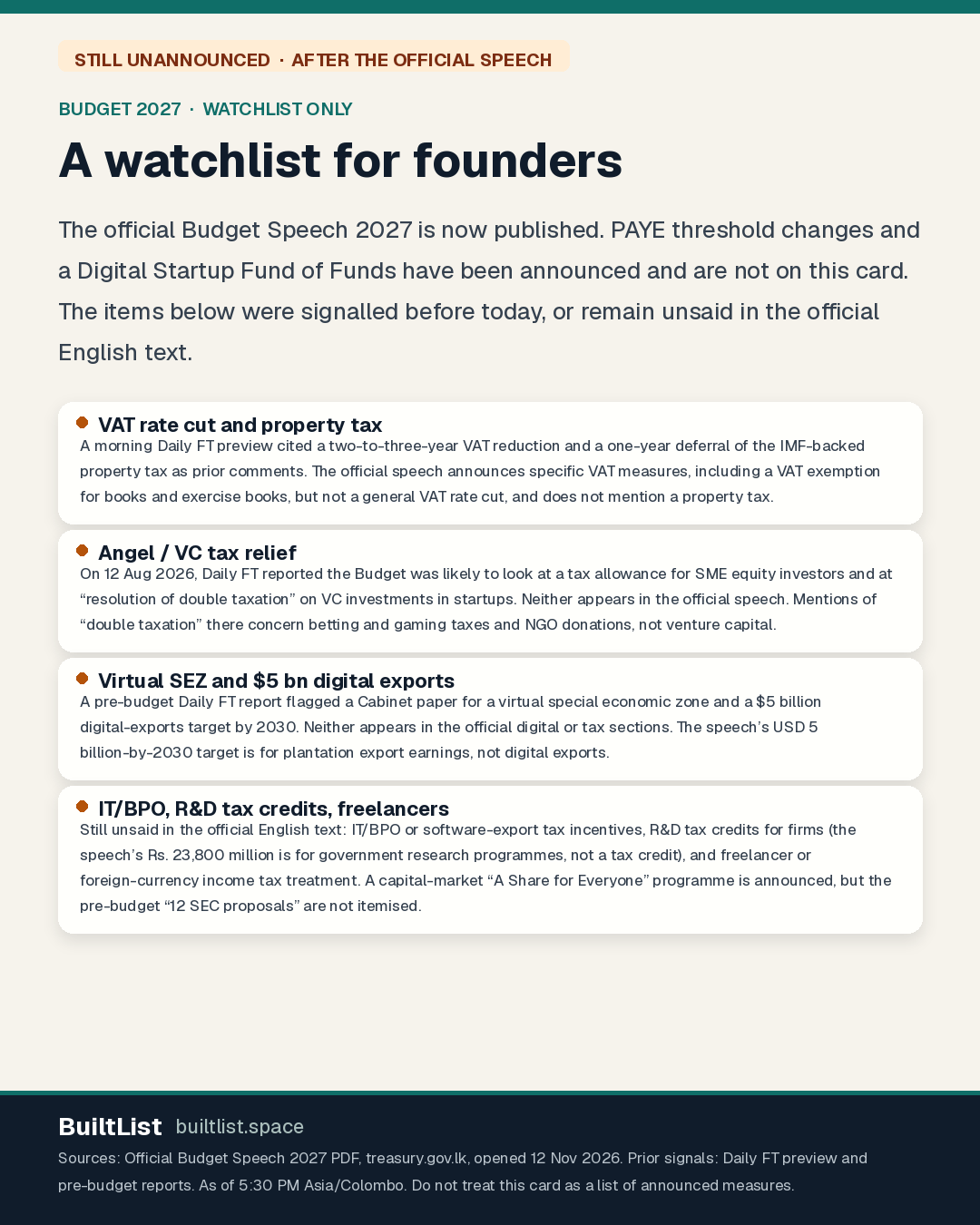
Still unsaid in the official English text: IT/BPO or software-export tax incentives, R&D tax credits for firms (the speech’s Rs. 23,800 million is for government research programmes, not a tax credit), and freelancer or foreign-currency income tax treatment. Annexure V does amend the source rule for income from remote and digital services, including online advertising and cloud services, by reference to the place of payment — a clarity measure, not a relief.
What founders should do next
- Read the fund, window and loan posts, then wait for rules. The official top-line is Rs. 18,500 million already allocated to the Ministry of Digital Economy, increased to Rs. 28,500 million. The startup-relevant slice is the Rs. 10,000 million package, which includes a Digital Startup Fund of Funds — but it is not yet a scheme you can apply to. The rural enterprise loan scheme at 4% now has an official cap of Rs. 5 million and a hiring condition; it is still not open for applications. The trade and investment windows, Cellular Tower Levy holiday, and digital-procurement guidelines are the same: direction, with more official detail than the live blogs, but not operational circulars.
- Recalculate payroll from 1 April 2027, and do not build plans on unpublished rules. The official speech raises the monthly personal-income-tax threshold to Rs. 162,500, and cuts the second band from 18% to 12%. If you invoice in foreign currency, wait for the CGIR circular on the VAT indicative rate; do not treat it as an income-tax exemption. See budget-2027-personal-income-tax-changes. A general VAT rate cut, angel/VC relief and a virtual SEZ were signalled before today and were not found as such in the official text. The Fund of Funds is now named, but still without rules.
- If you sell to government or process personal data, treat GoVTech, the amended PDPA and an “activated” Data Protection Authority as live context, and watch the Q1 2027 digital-economy bills and the undescribed new digital-procurement process. GovPay is already running; today’s line is adoption, not a launch.
- Remember the calendar. The second-reading debate runs from 13 to 20 November, with the vote at 6:00 PM on 20 November; the third-reading vote is at 6:00 PM on 14 December (Parliament news, 11 Nov 2026).
- Hear the industry read. SLASSCOM is hosting “National Budget 2027: Implications to the IT-BPM Industry” on Thursday 19 November 2026, 3:00–4:00 PM (venue, speakers and price not listed yet).
- We will update this piece if later documents change the picture. The official Budget Speech 2027 is now on the Treasury site; other 2027 booklets may still follow.
Figures checked against the official Budget Speech 2027 PDF and Newswire’s 6:07 PM, 6:10 PM and 6:12–6:20 PM updates on 12 November 2026, about 6:35 PM Asia/Colombo. Also checked against Daily Mirror, “Budget 2027 spending: where Sri Lanka’s money goes,” which reports the Digital economy allocation as Rs. 28.5 billion, raised from Rs. 18.5 billion. Not legal or tax advice.